01
Discover and inventory
Sync provider administration data, register manual credentials, and surface ghost, stale, orphaned, revoked, and unassigned keys in one operating view.
APIKeyOps gives security, platform, and finance teams one system to discover provider credentials, govern requests, protect secrets, attribute spend, and prove who did what.
Unified inventory
Provisioned, manual, and discovered credentials
Governed access
Requests, approvals, roles, teams, and projects
Evidence by design
Stable key identity and event-level audit history
Private deployment
Dockerized application and database stack
One control plane
AKO connects credential ownership, provider identity, policy posture, usage, and business context. Teams get a common operating model without losing provider-specific evidence.
Join early accessSync provider administration data, register manual credentials, and surface ghost, stale, orphaned, revoked, and unassigned keys in one operating view.
Route requests through approvals, business justification, team and project assignment, contextual roles, and delegated administration.
Use per-key envelope encryption, controlled reveal operations, replacement history, and audit events tied to a stable AKO identifier.
Evaluate expiry, provider, environment, tag, and replacement policies while attributing usage and spend to keys, models, teams, projects, and cost centers.
Inside the development build
These screens show the APIKeyOps development build. Interfaces and capabilities may change before release.
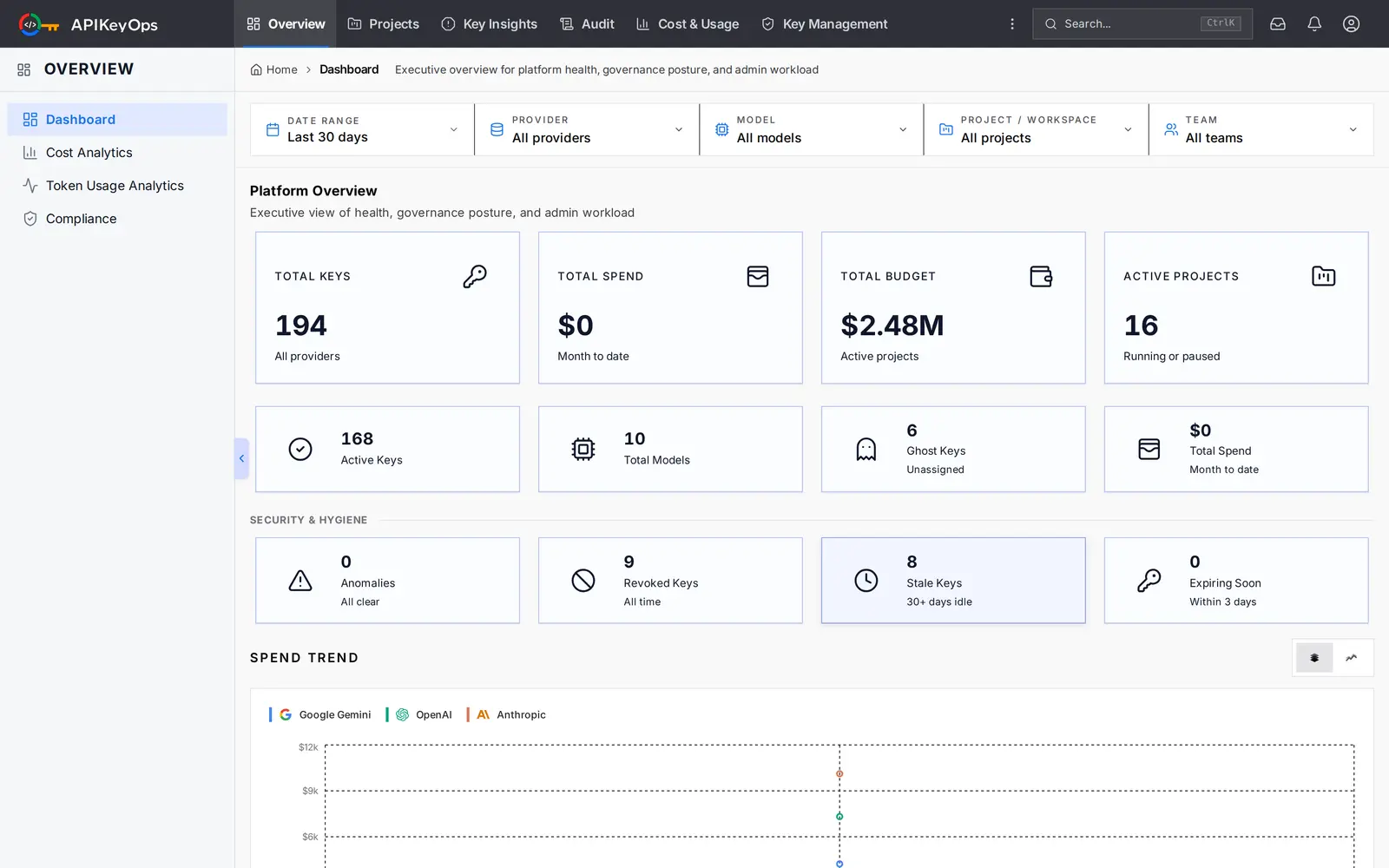
KPI tiles for governed keys, spend, budget, ghost and stale keys, with a live spend trend across providers.
Open the development preview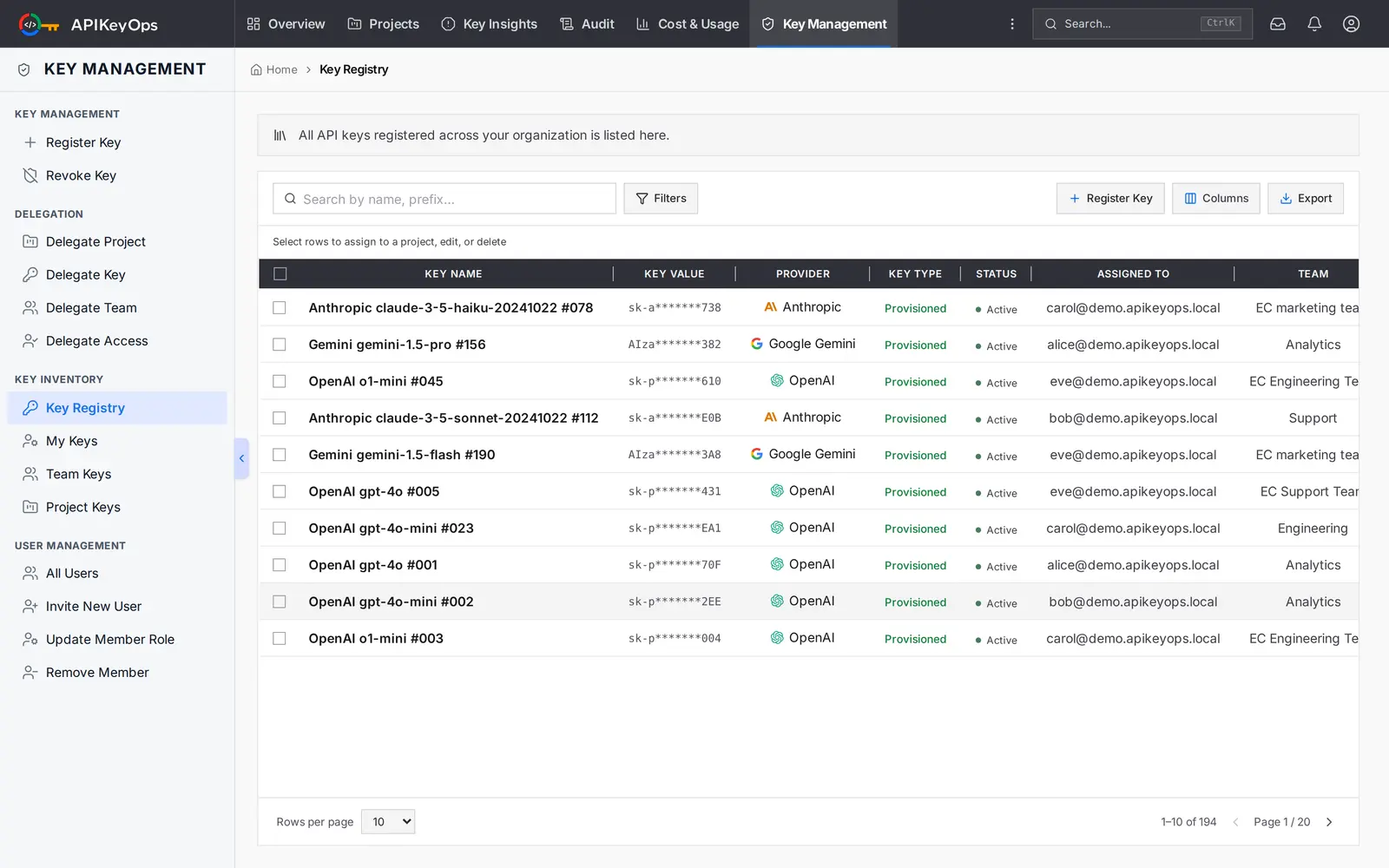
Every registered credential across the organization — provider, key type, status, and the team it is assigned to.
Open the development preview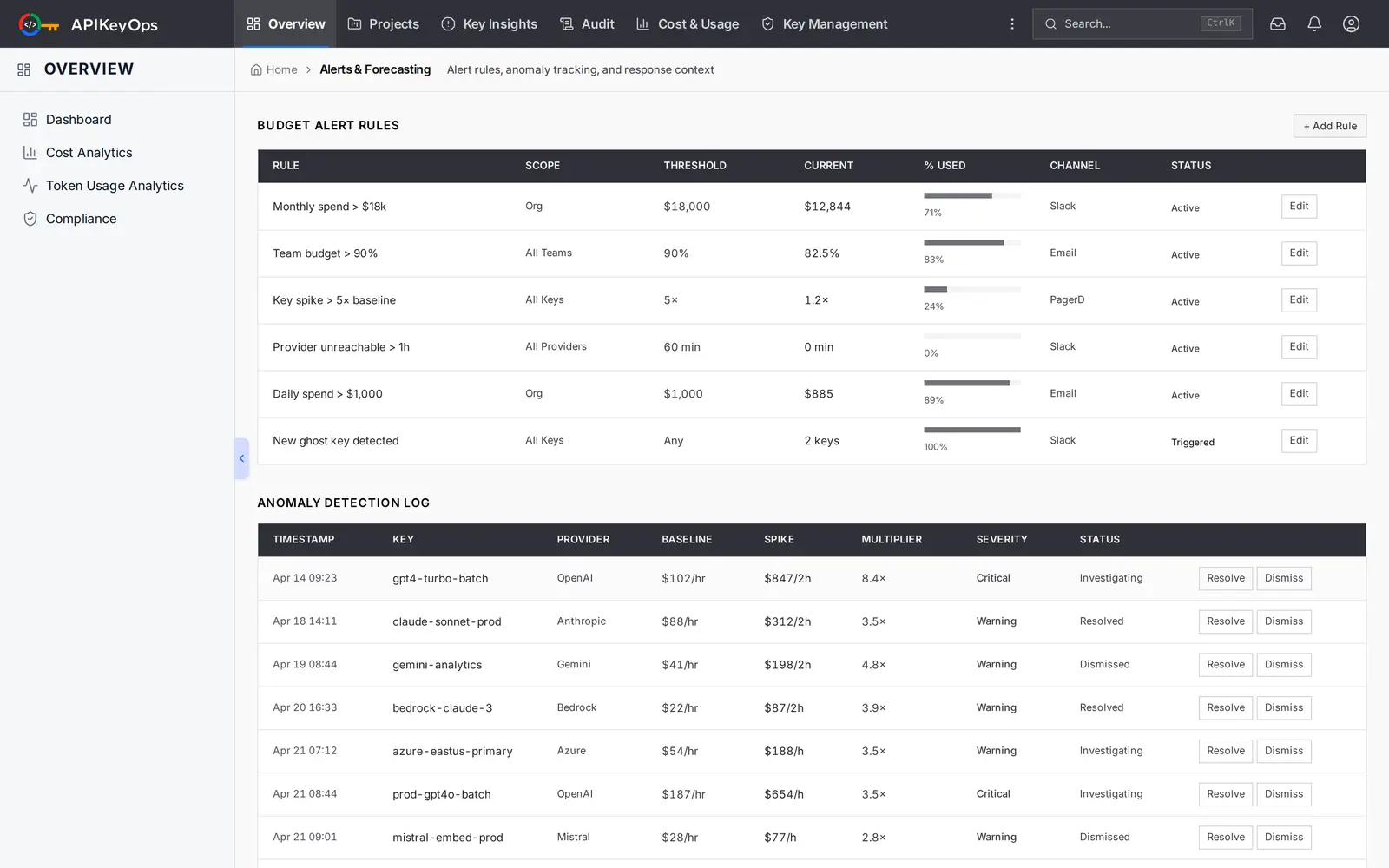
Budget alert rules with threshold tracking and an anomaly detection log scoring per-key cost spikes by severity.
Open the development preview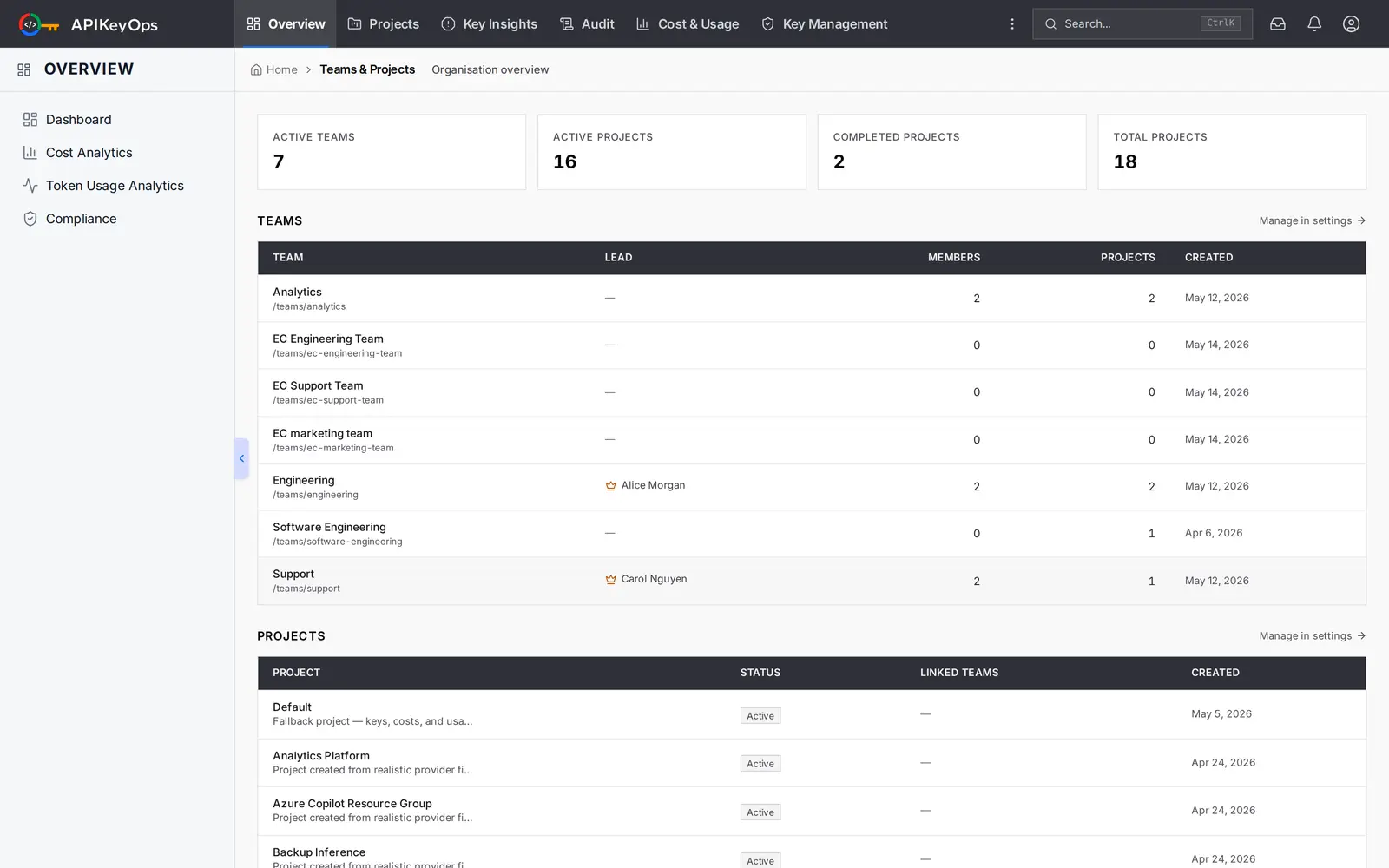
Budget accountability by team and project — members, key counts, and spend mapped to the right owners.
Open the development preview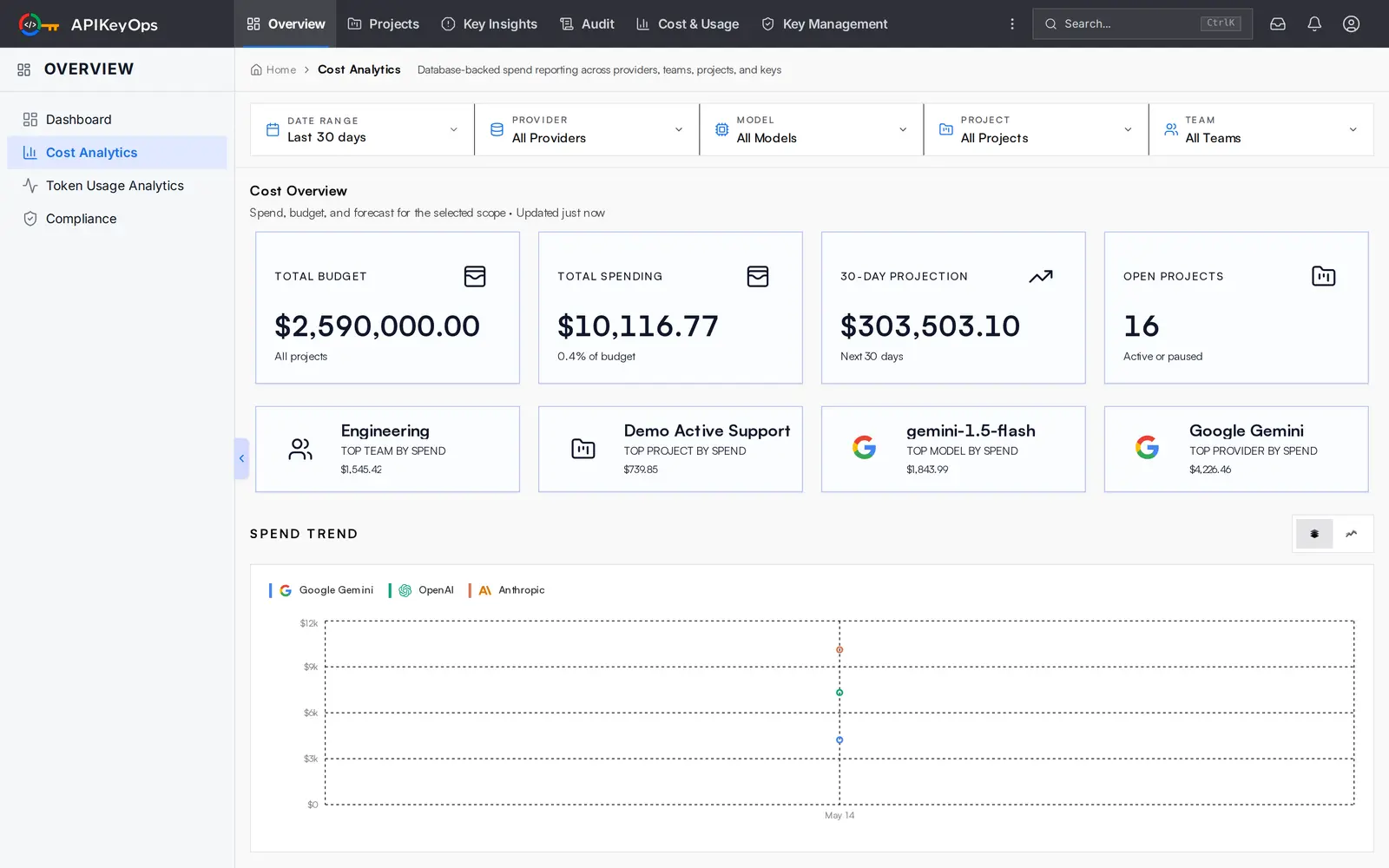
Spend, budget, and month-end projection by scope, with top team, project, model, and provider by spend.
Open the development previewEnterprise workflows
Find credentials that exist at providers but have no accountable owner. Review reveal, revoke, replacement, and backup activity from a central audit trail.
Standardize provider onboarding and key lifecycle operations across OpenAI, Anthropic, Google, and manually managed providers.
Trace provider cost and usage data to the keys, projects, teams, models, and cost centers responsible for consumption.
Request approved AI access without exchanging secrets in tickets, documents, or chat channels.
Credential security
AKO uses a two-layer envelope encryption design: a random data encryption key protects each credential, and a derived key encryption key protects each DEK. Plaintext is only exposed through controlled operations.
Credential protection path
Operator master key + protected seed
Derives the in-memory key encryption key
Random per-credential DEK
Encrypts one provider credential
Encrypted credential record
Stores ciphertext, nonces, and key version
Controlled use and zeroing
Decrypts only for an authorized operation
Frequently asked
AKO ships as a Dockerized application and database stack that runs inside your own environment. Credentials and audit data never leave your infrastructure.
OpenAI, Anthropic, and Google administration integrations are implemented in the current development build, alongside manually registered credentials for other providers. Launch availability may change before release.
Every credential is sealed with a per-key data encryption key under AES-256-GCM, and each DEK is wrapped by an Argon2id-derived key encryption key. Plaintext is only exposed through audit-logged, controlled operations.
Yes. Provider usage and cost data is traced to the keys, models, projects, teams, and cost centers responsible, so finance can report on consumption accurately.
Join the early-access list or request a development preview. APIKeyOps is still in development, so preview availability is limited and launch timing has not been announced.
Build the business case
We will map AKO to your providers, ownership model, approval process, deployment constraints, and reporting requirements.
For security: inventory, policy gaps, ownership, encryption, and audit evidence.
For engineering: provider administration, access requests, teams, projects, and delegation.
For finance: provider reports, model usage, project budgets, and cost centers.
Tell us what you need from API credential governance. We will share preview and release information as it becomes available.